Entity SEO: How AI Systems Recognize Your Brand as an Entity
Search is undergoing its biggest transformation since the introduction of PageRank.
For over two decades, businesses optimized websites to improve rankings on search engines. Success was measured through keywords, backlinks, impressions and click-through rates. While these signals remain important, they are no longer sufficient in a world increasingly shaped by artificial intelligence.
Today’s AI systems—including conversational assistants, AI-powered search experiences and recommendation engines—are designed to answer questions, not simply retrieve webpages. To do this effectively, they first need to understand the real-world entities behind the information they process.
An AI system does not inherently understand what a company is. It learns through evidence. It collects facts, validates relationships, resolves ambiguity and builds confidence that a particular organization, person, product or brand genuinely exists and can be trusted.
This process is known as entity recognition, and it is becoming one of the foundational capabilities that determines digital visibility.
Entity SEO is therefore not merely another optimization technique. It is the practice of making an organization machine-understandable by creating consistent, verifiable and interconnected digital signals that allow AI systems to recognize, validate and confidently reference that organization.
This guide explores how AI systems recognize entities, why knowledge graphs have become central to search, and how businesses can build a digital identity that machines understand as clearly as people do.
Search Has Changed: From Rankings to Recommendations
Traditional search engines were built around documents.
A user entered keywords, search engines retrieved webpages, and ranking algorithms determined which pages appeared first.
Modern AI systems operate differently.
Instead of asking:
“Which webpage best matches this query?”
they increasingly ask:
“Which organization can confidently answer this question?”
This subtle shift changes the objective of optimization.
Businesses are no longer competing only for rankings. They are competing to become recognized sources of truth.
This distinction explains why many organizations with technically optimized websites still struggle to appear in AI-generated answers.
AI cannot confidently recommend an organization it does not clearly recognize.
Entity recognition is the prerequisite for AI recommendation.
From Websites to Digital Entities
A website is a collection of webpages.
An entity is a machine-recognized representation of something that exists in the real world.
This distinction is fundamental.
Consider two manufacturing companies with nearly identical websites.
Both publish product pages.
Both maintain blogs.
Both have optimized metadata.
However, one company is consistently referenced across industry directories, government registrations, trade associations, export records and structured data. The other is not.
To a human visitor, the websites may appear equally credible.
To an AI system, they are fundamentally different.
One organization exists as a connected entity.
The other exists primarily as isolated webpages.
Entity SEO bridges that gap.
What Is an Entity?
An entity is a uniquely identifiable object, concept or organization that exists independently of language.
Entities include:
Organizations
Brands
Products
Services
People
Locations
Events
Technologies
Publications
Unlike keywords, entities possess identity.
For example:
Keyword
Entity
best textile exporter
Jawahar Group
commercial treadmill
KFS Fitness U-02 Treadmill
AI marketing agency
Digiactus
electric vehicle
Tesla Model Y
Keywords describe topics.
Entities identify things.
AI systems reason primarily about entities.
Why AI Systems Prefer Entities Over Keywords
Keywords are inherently ambiguous.
A search for “Jaguar” could refer to:
the animal
the automobile manufacturer
a sports team
software
a brand name
Humans resolve this ambiguity using context.
AI must do the same.
Entities provide that context.
Instead of matching words, AI connects relationships.
For example:
Jaguar
↓
is a
↓
Vehicle Manufacturer
↓
Owned by
↓
Jaguar Land Rover
↓
Produces
↓
SUVs
↓
Competes with
↓
BMW
↓
Located in
↓
United Kingdom
These relationships remove uncertainty.
The more connected an entity becomes, the easier it is for AI to understand it.
How AI Systems Recognize Organizations
One common misconception is that AI systems recognize organizations because they publish more content.
Our observations suggest something different.
Recognition develops through accumulated evidence.
Rather than trusting a single webpage, AI systems compare information across numerous publicly available sources, including:
Official websites
Structured data
Company registrations
Industry associations
Business directories
Government databases
Media publications
Product catalogues
Research papers
Professional profiles
Customer references
Each consistent reference increases confidence.
Each contradiction introduces uncertainty.
Entity SEO focuses on reducing that uncertainty.
The Four Stages of Entity Recognition
One of the recurring concepts throughout Digiactus’ research is that AI recognition develops progressively rather than instantly.
We describe this process as the Four Stages of Entity Recognition.
Stage 1 — Discovery
The organization becomes visible.
AI systems discover references through websites, business listings, articles, directories and structured data.
Without discovery, recognition cannot begin.
Stage 2 — Identification
AI determines whether multiple references describe the same organization.
Questions include:
Is this the same company?
Does this website belong to the same organization?
Are these products owned by this brand?
Identity consistency becomes critical.
Stage 3 — Validation
AI begins verifying facts.
Examples include:
company name
ownership
location
products
services
founders
industry
Agreement across independent sources increases confidence.
Conflicting information reduces it.
Stage 4 — Authority
Once sufficient confidence develops, AI increasingly trusts the organization when answering questions.
Authority is not assigned.
It is accumulated.
Entity Recognition Is an Evidence-Building Process
Many discussions around SEO focus on optimization.
Entity recognition is better understood as evidence accumulation.
Every reliable digital signal contributes to a larger body of evidence.
Examples include:
Organization schema
Consistent branding
Founder profiles
Product ownership
Business registrations
Certifications
Industry memberships
Publications
Customer case studies
Press mentions
None of these signals work independently.
Together they create a machine-verifiable identity.
This evidence-based perspective distinguishes Entity SEO from traditional website optimization.
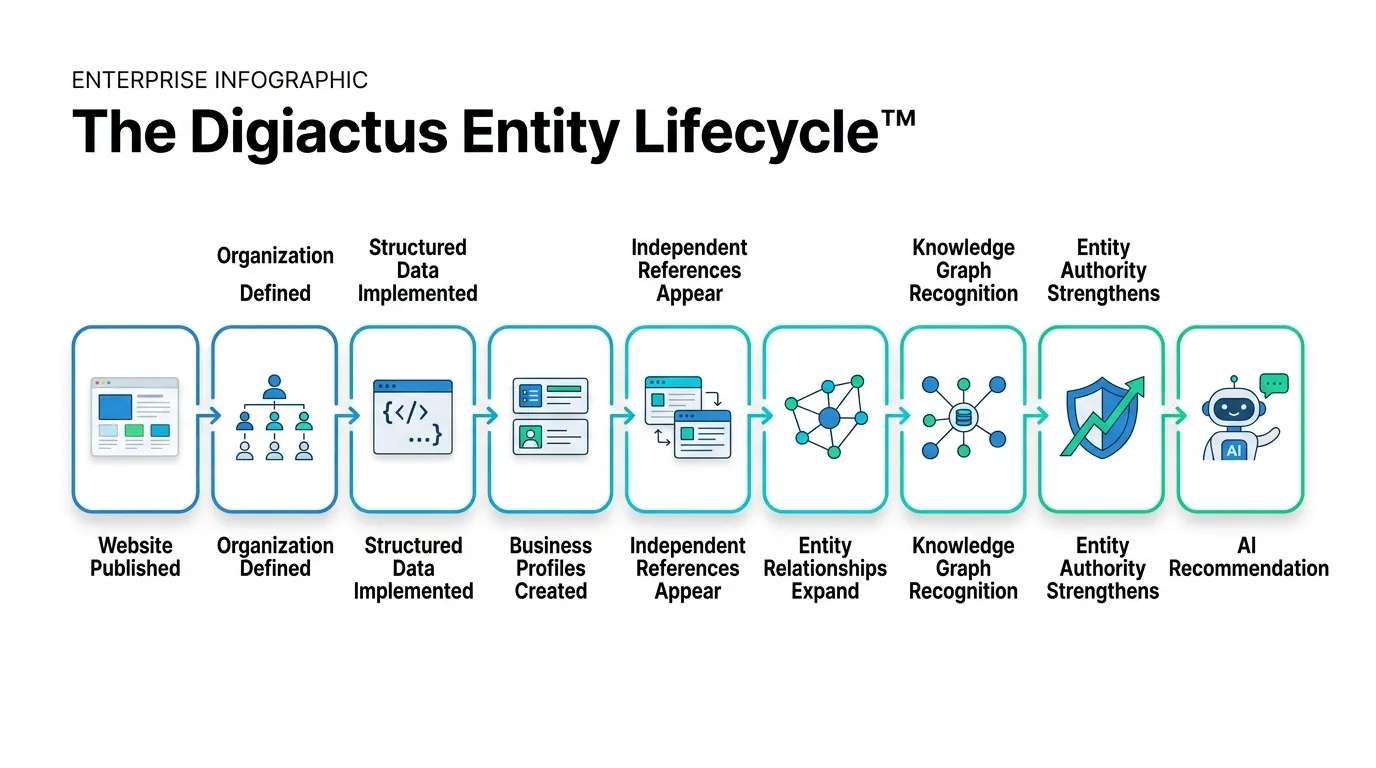
The Entity Lifecycle
Organizations do not become recognized overnight.
How organizations evolve from simple websites into machine-recognized entities trusted by AI systems.
Recognition develops gradually through what Digiactus refers to as the Entity Lifecycle.
Website Published
        ↓
Organization Defined
        ↓
Structured Data Implemented
        ↓
Business Profiles Created
        ↓
Independent References Appear
        ↓
Entity Relationships Expand
        ↓
Knowledge Graph Recognition
        ↓
Authority Strengthens
        ↓
AI Recommendation
Each stage reinforces the next.
Organizations that interrupt this lifecycle—for example by frequently changing branding or maintaining inconsistent information—slow the recognition process.
Entity Ambiguity: The Hidden Visibility Problem
Many businesses unknowingly create ambiguity.
Consider names such as:
Apple
Oracle
Delta
Pioneer
Jaguar
Without supporting relationships, AI cannot immediately determine which entity is being referenced.
The same issue affects smaller organizations.
For example:
abbreviations
multiple trading names
inconsistent legal names
disconnected product brands
Entity SEO reduces ambiguity by surrounding an organization with contextual relationships.
Instead of simply stating:
“ABC Industries”
AI learns:
ABC Industries

↓

Manufactures

↓

Industrial Pumps

↓

Located in

↓

Ahmedabad

↓

Exports to

↓

Middle East

↓

Founded in

↓

1998

↓

Owns

↓

XYZ Brand
Context transforms a name into a recognizable entity.
Why Brand Recognition Matters to AI
Humans recognize brands visually.
AI recognizes brands structurally.
A recognizable brand is not defined by its logo alone.
Instead, AI evaluates whether it can confidently answer questions such as:
Who owns this brand?
What products belong to it?
Which industry does it serve?
Where is it located?
Which services does it provide?
Which organizations reference it?
Brand recognition therefore becomes a function of digital clarity rather than visual familiarity.
Introducing Entity Authority Engineering™
One concept referenced throughout Digiactus’ AI Visibility methodology is Entity Authority Engineering™.
Rather than treating authority as something that emerges accidentally, Entity Authority Engineering™ views it as a structured process of strengthening the evidence AI systems use to recognize an organization.
It involves improving:
organizational identity
ownership clarity
digital consistency
structured information
entity relationships
external validation
authoritative references
Knowledge Graph Architecture – How AI Systems Build a Machine-Readable Understanding of Your Business
AI systems increasingly recognize organizations as entities rather than simply indexing webpages. Recognition, however, is only the beginning.
Once an AI system identifies an organization, it attempts to answer a more complex question:
How does this organization relate to everything else I know?
The answer lies in Knowledge Graphs.
Knowledge graphs are one of the most important concepts in modern AI and search because they enable machines to organize information as connected facts rather than disconnected documents.
For businesses, this represents a fundamental shift in digital strategy.
Success is no longer determined solely by publishing more content. It depends on whether AI systems can connect your company, products, services, people, locations and expertise into a coherent, verifiable network of relationships.
This chapter explains how that process works using the Enterprise AI SEO Architecture Diagram.
The Enterprise AI SEO Architecture
Insert Figure 1: Enterprise AI SEO Architecture – Digital Ecosystem Diagram
Figure 1. Enterprise AI SEO Architecture illustrating how websites, structured data, entity relationships, search engines and AI platforms contribute to knowledge graph construction.
Unlike conventional SEO diagrams that end with search engine rankings, this architecture illustrates something much broader:
AI systems continuously collect, structure, validate and connect information before generating answers.
The knowledge graph sits at the centre of this process.
It functions as the machine’s understanding of your organization.
Understanding the Architecture
The architecture can be divided into six interconnected layers.
Each layer contributes to AI’s understanding of your business.
Rather than working independently, they continuously exchange information and strengthen one another.
Layer 1 — The Digital Footprint
Every organization begins with a digital footprint.
This is the total collection of publicly available information describing the business.
Examples include:
Corporate website
Product catalogue
Service pages
Company profile
About page
Leadership pages
Blogs
Whitepapers
Press releases
Research publications
Videos
Case studies
PDF brochures
Business directories
Government registrations
Most organizations view these assets individually.
AI views them collectively.
Every document contributes another piece of evidence.
Digital Footprint Is More Than a Website
Many organizations invest heavily in website optimization while neglecting everything beyond their domain.
AI systems do not.
They compare information across hundreds of independent sources.
For example, if your homepage states:
“We manufacture industrial automation equipment.”
AI immediately begins asking additional questions:
Is this statement supported elsewhere?
Are products associated with this company?
Do distributor websites reference the same manufacturer?
Do industry associations mention this organization?
Does structured data confirm these claims?
The broader and more consistent the digital footprint becomes, the stronger the entity.
Layer 2 — Structured Data: Translating Human Content into Machine Facts
Human beings understand paragraphs.
Machines prefer structured facts.
Structured data acts as a translation layer between these two worlds.
Instead of reading:
Digiactus is an AI Visibility agency headquartered in New Delhi.
AI receives explicit relationships such as:
Organization

Name → Psych

Industry → Agency

Location → Santa Barbara

Founder → Shawn Spencer

Website → psych.com

Provides Service → Entity Evaluation

Provides Service → Visibility Services
This reduces ambiguity.
Rather than guessing relationships, machines receive clearly defined facts.
Why Structured Data Alone Is Not Enough
A common misconception is that implementing Schema.org markup automatically creates entity recognition.
It does not.
Structured data provides claims.
AI still needs to determine whether those claims are trustworthy.
For example:
A website may claim:
Industry Leader
Global Manufacturer
Trusted Supplier
AI does not simply accept those statements.
Instead, it attempts to validate them using external evidence.
Structured data accelerates understanding.
It does not replace verification.
Layer 3 — Entity Relationships: The Language of Knowledge Graphs
The centre of the architecture contains the most important component:
The Knowledge Graph
A knowledge graph is not a database of webpages.
It is a database of relationships.
Imagine a manufacturing company.
Traditional search stores documents.
Knowledge graphs store connections.
Organization
        │
        ├── manufactures → Products
        │
        ├── located in → Country
        │
        ├── founded by → Founder
        │
        ├── owns → Brand
        │
        ├── exports to → Markets
        │
        ├── certified by → Authority
        │
        ├── employs → Experts
        │
        └── publishes → Research
Every relationship becomes another edge in the graph.
Instead of isolated facts, AI develops contextual understanding.
Why Relationships Matter More Than Keywords
Consider these two statements.
Website A
We manufacture commercial gym equipment.
Website B
Organization

↓

Manufactures

↓

Commercial Gym Equipment

↓

Supplies

↓

Fitness Centres

↓

Located in

↓

India

↓

Exports to

↓

15 Countries

↓

Certified by

↓

ISO

↓

Owns

↓

Five Product Lines

The second description gives AI far more context.
Relationships answer questions.
Keywords simply describe topics.
Relationship Density and Entity Confidence
One observation from our work is that organizations with richer relationship networks tend to be easier for AI systems to understand.
A company connected to:
founders
products
services
industries
locations
distributors
certifications
publications
customers
provides substantially more context than an organization described only by its homepage.
We refer to this characteristic as Relationship Density.
Relationship Density is not the number of webpages.
It is the number of meaningful relationships AI can verify.
Higher relationship density generally leads to stronger entity confidence because the organization becomes easier to distinguish from similar businesses.
Layer 4 — Continuous Validation
The architecture diagram illustrates arrows flowing continuously between:
Search Engines
Structured Data
Knowledge Graph
Content Repository
This reflects an important reality.
AI systems never stop validating.
Recognition is dynamic.
Every new webpage…
Every new press release…
Every updated company profile…
Every external mention…
becomes another opportunity to strengthen—or weaken—the entity.
What AI Validates
AI continuously checks questions such as:
Does this organization still exist?
Has the company changed names?
Are founders consistent?
Are products still associated with the same brand?
Has ownership changed?
Is the address consistent?
Do independent sources agree?
Validation is an ongoing process rather than a one-time event.
Layer 5 — Retrieval Before Reasoning
The upper portion of the architecture contains AI platforms including:
ChatGPT
Gemini
Microsoft Copilot
Perplexity
Notice that these systems connect first to retrieval.
Generation comes later.
This distinction is essential.
Large Language Models do not answer questions solely from memory.
They increasingly retrieve information from trusted sources before constructing responses.
Suppose someone asks:
Who manufactures commercial gym equipment in India?
The AI does not immediately generate text.
Instead it attempts to retrieve relevant entities such as:
manufacturers
products
export companies
certifications
locations
research
trusted references
Only after retrieval does reasoning begin.
This explains why organizations with stronger entity recognition are more likely to appear in AI-generated responses.
Layer 6 — Users Never See the Knowledge Graph
One of the most fascinating aspects of AI systems is that users never interact directly with the knowledge graph.
They interact with natural language.
Behind every conversational answer lies thousands of connected relationships.
When a user asks:
Which Indian companies manufacture commercial fitness equipment?
The response may appear conversational.
Internally, AI has already connected:
Organization

↓

Industry

↓

Products

↓

Manufacturing

↓

Location

↓

Authority

↓

External Validation

↓

Evidence
The knowledge graph remains invisible.
Its influence is not.
From Website to Knowledge Graph
One of the biggest misconceptions in digital marketing is that publishing content automatically leads to visibility.
In reality, organizations pass through a much longer process.
Website
        ↓
Content
        ↓
Structured Data
        ↓
Entity Identification
        ↓
Relationship Mapping
        ↓
Knowledge Graph Construction
        ↓
Entity Validation
        ↓
Authority Assessment
        ↓
AI Retrieval
        ↓
Generated Answers
Every stage introduces opportunities for ambiguity.
Entity SEO exists to reduce that ambiguity.
Knowledge Graphs Resolve Ambiguity
Entity ambiguity is one of the least discussed challenges in AI visibility.
Consider the word:
Apple
Without context AI cannot determine whether this refers to:
Apple Inc.
the fruit
a music label
a local business named Apple
Knowledge graphs solve ambiguity through relationships.
Apple

↓

Technology Company

↓

Founded by

↓

Steve Jobs

↓

Produces

↓

iPhone

↓

Headquartered in

↓

California
Relationships transform a word into a unique entity.
The same principle applies to every organization regardless of size.
The Digiactus Perspective: Knowledge Graphs Are Evidence Networks
Knowledge graphs should not be viewed as technical databases.
They are evidence networks.
Every relationship contributes another piece of evidence supporting organizational identity.
For example, a manufacturing company might be connected through:
Government registrations
Export documentation
Product catalogues
Certifications
Industry memberships
Trade exhibitions
Dealer networks
Technical documentation
Customer case studies
Individually, these assets appear unrelated.
Collectively, they establish a machine-verifiable identity.
This is why successful Entity SEO extends beyond websites.
It encompasses the entire digital ecosystem.
Introducing the Concept of Entity Decay
Recognition is not permanent.
Organizations can gradually lose confidence within AI systems when digital signals become inconsistent.
We refer to this process as Entity Decay.
Common causes include:
Company rebranding without updating external references.
Multiple versions of the organization name.
Outdated structured data.
Broken relationships between products and brands.
Discontinued domains.
Inconsistent addresses.
Obsolete company profiles.
Entity Decay rarely occurs overnight.
Instead, confidence gradually erodes as contradictions accumulate.
Maintaining a healthy digital ecosystem is therefore as important as building one.
Key Insights
This study demonstrates that AI systems do not simply crawl websites—they construct a machine-readable understanding of organizations through interconnected relationships.
The Knowledge Graph acts as the central intelligence layer, continuously combining content, structured data, validation signals and external evidence into a unified representation of an entity.
Several practical implications emerge:
A website is only one component of your digital identity.
Structured data improves understanding but does not establish trust on its own.
Rich, verifiable relationships strengthen entity confidence more effectively than isolated content.
Continuous validation means entity recognition is an ongoing process rather than a one-time achievement.
Organizations that maintain a consistent, interconnected digital footprint are easier for AI systems to retrieve, reason about and reference.
These observations reinforce the central premise introduced above: AI recommendations are built on evidence, and knowledge graphs are the structures through which that evidence is organized.
Entity Authority Engineering™ – The Seven Entity Signals AI Systems Use
We examined how AI systems build knowledge graphs from websites, structured data and digital relationships.
A knowledge graph, however, is only a representation.
It does not explain why one organization becomes highly recognizable while another remains largely invisible, even when both publish similar content.
This chapter explores that distinction.
Based on observations from manufacturing, healthcare, technology and professional service organizations, Digiactus proposes that AI recognition is influenced by seven interconnected categories of evidence. We collectively describe this framework as Entity Authority Engineering™.
Entity Authority Engineering™ is not another SEO checklist. It is a methodology for strengthening the machine-readable identity of an organization by improving the quality, consistency and credibility of the signals AI systems use to evaluate trust.
Unlike traditional optimization approaches that focus on individual webpages, Entity Authority Engineering™ focuses on the organization itself.
What Is Entity Authority Engineering™?
Authority has traditionally been associated with backlinks, domain metrics or brand awareness.
AI systems evaluate authority differently.
They attempt to answer questions such as:
Is this organization real?
Is its identity consistent?
Do independent sources describe it similarly?
Are its products clearly associated with it?
Are ownership relationships well defined?
Does sufficient external evidence exist to trust this organization?
Authority therefore becomes an outcome of evidence rather than popularity.
The systematic process of strengthening the identity, relationships, validation signals and digital evidence that enable AI systems to recognize an organization as a trusted entity.
This engineering process extends across an organization’s complete digital footprint—not only its website.
The Digiactus Entity Authority Framework™
Our research suggests that AI confidence develops from seven categories of evidence.
Rather than working independently, these signals reinforce one another.
Weakness in one area can often reduce the effectiveness of the others.
Together, they form the Seven Entity Signals AI Systems Use.
Signal 1 – Identity Consistency
Recognition begins with identity.
If AI cannot determine that multiple references describe the same organization, authority cannot develop.
Identity consists of more than a company name.
It includes:
Legal entity name
Brand name
Website
Logo
Contact details
Registered address
Founders
Parent organization
Subsidiaries
Brand ownership
Organizations often create inconsistency unintentionally.
Examples include:
Different company names on invoices and websites
Multiple logo variations
Separate domains representing the same organization
Different spellings across directories
Outdated addresses
Unclear ownership between brands
Humans can often overlook these inconsistencies.
Machines cannot.
Identity consistency is therefore the foundation upon which all other entity signals are built.
Signal 2 – Structured Understanding
Machines require structured information before they can reason.
While webpages communicate with people, structured data communicates with machines.
Schema helps AI understand:
Organization

↓

Provides Service

↓

Owns Brand

↓

Manufactures Product

↓

Located In

↓

Founded By

↓

Same As

↓

Contact Point

This information reduces ambiguity and accelerates machine understanding.
However, structured information should accurately represent reality.
Schema does not create trust.
It communicates facts that AI attempts to verify.
Signal 3 – Relationship Strength
Organizations do not exist in isolation.
Every business operates within a network.
These relationships provide context.
Examples include:
Organization

↓

Founder

↓

Products

↓

Services

↓

Employees

↓

Industries

↓

Customers

↓

Partners

↓

Suppliers

↓

Certifications

↓

Locations

↓

Research

The greater the number of meaningful, verifiable relationships, the easier AI systems can distinguish one organization from another.
We describe this characteristic as Relationship Strength.
Relationship Strength differs from Relationship Density discussed in Part 2.
Density measures how many relationships exist.
Strength measures how confidently AI can verify them.
Signal 4 – Independent Validation
One of the strongest observations from our projects is that AI rarely relies upon self-published information alone.
Organizations describe themselves.
Authority develops when others describe them similarly.
Independent validation may include:
Industry associations
Government registrations
Certification bodies
Media coverage
Universities
Research publications
Trade exhibitions
Business directories
Awards
Conference speakers
Every independent confirmation reduces uncertainty.
Entity recognition develops when all seven signals reinforce one another.
The Digiactus AI Visibility Quotient™ (AVQ™)
Traditional SEO measures rankings.
AI visibility requires different measurements.
To evaluate organizational readiness for AI-driven search, Digiactus uses the AI Visibility Quotient™ (AVQ™).
Rather than focusing on positions within search results, AVQ™ evaluates how effectively an organization communicates its identity to AI systems.
The framework consists of three complementary dimensions.
1. Foundation Score
The Foundation Score measures the strength of an organization’s machine-readable identity.
It considers factors such as:
Identity consistency
Organization clarity
Structured information
Ownership definition
Brand relationships
Entity completeness
A weak foundation often indicates that AI systems may struggle to identify the organization accurately.
2. Visibility Score
Visibility measures how extensively the organization appears within the broader digital ecosystem.
Typical indicators include:
Knowledge graph presence
Industry references
Citation frequency
Digital footprint breadth
External validation
Relationship coverage
Organizations with higher visibility provide AI systems with more evidence from which to build confidence.
3. Business Impact Score
Ultimately, entity recognition should contribute to business outcomes.
The Business Impact Score evaluates whether stronger entity recognition influences commercial performance.
Possible indicators include:
AI referral traffic
AI-assisted enquiries
Brand recall
Recommendation frequency
High-intent user engagement
Qualified lead generation
This separates technical improvements from measurable business value.
Measuring Entity Maturity
Recognition develops progressively.
Based on our observations, organizations generally move through five stages of maturity.
Level 1 – Identified
The organization exists online but provides limited structured identity.
Recognition remains inconsistent.
Level 2 – Validated
Identity becomes clearer.
Independent sources begin corroborating organizational information.
Level 3 – Connected
Products, services, people and locations become linked through structured relationships.
Knowledge graph development accelerates.
Level 4 – Trusted
AI demonstrates increasing confidence when retrieving organizational information.
Authority strengthens.
Recognition expands across multiple contexts.
Level 5 – Authoritative
The organization consistently appears as a trusted reference within its area of expertise.
Recognition extends beyond its own website into the broader digital ecosystem.
Industry Observations
Entity Authority Engineering applies across industries.
However, the signals differ.
Manufacturing
Manufacturers frequently operate:
One Company

↓

Multiple Brands

↓

Hundreds of Products

↓

Dealers

↓

Export Records

↓

Trade Exhibitions

↓

Distributors

↓

Government Registrations

↓

Technical Catalogues

These fragmented assets create significant identity challenges.
Healthcare
Healthcare organizations typically involve relationships between:
Doctors

↓

Clinics

↓

Hospitals

↓

Treatments

↓

Specialties

↓

Locations

↓

Medical Publications

↓

Professional Registrations

Strong entity relationships improve clarity.
Professional Services
Professional service firms depend heavily upon:
People

↓

Expertise

↓

Research

↓

Publications

↓

Locations

↓

Client Success

↓

Speaking Engagements

↓

Industry Recognition
People often become the strongest entity associated with the firm.
Fitness & Consumer Products
Consumer brands typically manage:
Corporate Entity

↓

Brand

↓

Product Models

↓

Specifications

↓

Retailers

↓

Distributors

↓

Reviews

↓

Documentation

Maintaining clear ownership across these assets is essential for entity recognition.
Original Observation: Strong Brands Are Usually Well-Connected Brands
One recurring observation across our projects is that organizations achieving stronger AI visibility are not necessarily those with the largest websites.
Instead, they demonstrate stronger connectivity.
Their products connect clearly to brands.
Brands connect to organizations.
Organizations connect to founders.
Founders connect to expertise.
Expertise connects to publications.
Publications connect to industry recognition.
This network of evidence enables AI systems to build confidence.
Entity Authority Engineering therefore focuses less on creating isolated content and more on strengthening organizational relationships.
Key Insights
Entity Authority Engineering™ reframes authority as a measurable outcome of consistent, verifiable evidence rather than a by-product of rankings or popularity.
The seven signals presented in this chapter—Identity Consistency, Structured Understanding, Relationship Strength, Independent Validation, Digital Footprint, Entity Authority and Historical Stability—work together to shape how AI systems recognize and trust organizations.
The AI Visibility Quotient™ extends this idea by providing a structured way to evaluate readiness across three dimensions: Foundation, Visibility and Business Impact.
Finally, entity maturity demonstrates that recognition is not binary. Organizations progress through identifiable stages, gradually evolving from being merely present online to becoming authoritative entities within their industries.
Applying Entity SEO in Practice – Industry Research, Case Studies and the Future of AI Recognition
We have explored how AI systems move beyond webpages to recognize organizations as entities. We examined how knowledge graphs organize information, how Entity Authority Engineering™ strengthens machine-readable identity, and why evidence—not claims—drives AI confidence.
The remaining question is practical:
What does Entity SEO look like in the real world?
This chapter answers that question by examining common entity recognition challenges across industries, observations from Digiactus client engagements, and the characteristics consistently found in organizations that achieve stronger AI visibility.
Unlike traditional SEO discussions that focus on rankings or traffic, this chapter concentrates on organizational clarity—the quality that allows AI systems to understand, validate and confidently reference a business.
Different Industries Face Different Entity Challenges
Every industry generates a unique network of entities and relationships.
Although the principles of Entity SEO remain consistent, the signals that matter most vary considerably.
Understanding these differences helps organizations prioritize the relationships AI systems are most likely to evaluate.
Manufacturing: Complex Organizations with Fragmented Digital Identities
Manufacturing businesses often have rich operational capabilities but fragmented digital ecosystems.
Company
      ↓
Brand
      ↓
Equipment Series
      ↓
Individual Models
      ↓
Specifications
      ↓
Dealers
      ↓
Commercial Installations
Without consistent ownership signals, AI systems may struggle to associate equipment models with the parent organization.
Professional Services
Professional service firms present another unique challenge.
Their strongest entity is often not the company.
It is the people.
Relationships commonly include:
Founders
Consultants
Publications
Research
Conferences
Clients
Industry associations
Organizations that clearly connect expertise to individuals generally develop stronger authority.
Case Study: Strengthening Entity Recognition for a Manufacturing Brand
One of the most valuable observations from our work involved a manufacturing organization serving domestic and international buyers.
Although the company possessed decades of experience and an extensive product portfolio, AI systems demonstrated inconsistent recognition of its manufacturing capabilities.
The organization faced several challenges:
Product categories spread across multiple sections of the website.
Technical catalogues disconnected from the corporate identity.
Rather than focusing solely on keyword rankings, the engagement prioritized organizational clarity.
Activities included:
Standardizing organization identity across digital assets.
Strengthening ownership relationships between products and the company.
Improving structured descriptions of manufacturing capabilities.
Connecting products, services and export expertise.
Reinforcing digital consistency across external references.
Observation
As the organization’s digital identity became more coherent, AI systems increasingly associated the manufacturer with its products and export capabilities.
This reinforced an important principle discussed throughout this guide:
When AI clearly understands who an organization is, it becomes significantly easier for AI to understand what the organization offers.
Observations Across Digiactus Projects
Although every project is unique, several recurring themes have emerged.
Organizations achieving stronger AI visibility typically demonstrate:
Clear Organizational Identity
The same company name, branding and ownership appear consistently across digital assets.
Well-Defined Relationships
Products, services, founders and expertise are explicitly connected.
Strong External Validation
Independent sources reinforce rather than contradict organizational information.
Rich Digital Footprints
The organization contributes original material beyond marketing pages.
Research, technical documentation, case studies and publications all strengthen recognition.
Stable Digital Histories
Older organizations frequently benefit from years of accumulated evidence, provided their identity has remained consistent.
The Difference Between Visibility and Recognition
Many organizations appear in search results.
Far fewer become recognized entities.
Visibility answers:
Can users find the website?
Recognition answers:
Does AI understand the organization?
An organization may rank highly for several keywords while remaining poorly understood by AI systems.
Conversely, organizations with strong entity recognition often appear across multiple AI-generated experiences because their identity is clear, connected and well supported.
Common Reasons Organizations Remain Difficult to Recognize
Entity recognition problems rarely stem from a single issue.
Instead, they emerge from accumulated ambiguity.
Common causes include:
Fragmented Brand Identity
Different versions of the company name appear across websites, directories and publications.
Weak Ownership Signals
Products, services or subsidiaries are not clearly associated with the parent organization.
Disconnected Digital Assets
Websites, PDFs, social profiles and business listings exist independently rather than reinforcing one another.
Missing Context
Organizations describe products but fail to explain relationships.
AI understands products more effectively when it also understands manufacturers, founders, industries and locations.
Limited External Evidence
Organizations relying solely on self-published content often provide insufficient validation.
From Content Marketing to Knowledge Publishing
One observation increasingly shaping AI visibility is the difference between publishing content and publishing knowledge.
Many websites produce:
Blogs
Landing pages
Promotional articles
Fewer produce:
Research
Industry observations
Original frameworks
Technical documentation
Methodologies
Comparative analysis
Educational resources
AI systems increasingly value organizations that contribute knowledge rather than simply promote services.
This research guide is an example of that philosophy.
Rather than describing Entity SEO as a service, it attempts to explain the underlying principles through original frameworks, terminology and observations.
The Future of Entity SEO
Entity SEO is still evolving.
Several trends appear likely to influence its future.
Greater Emphasis on Relationships
Organizations will increasingly compete through relationship quality rather than keyword density.
Knowledge Graph Expansion
Knowledge graphs will continue growing as AI systems integrate structured and unstructured information from more sources.
Entity-Level Trust
Trust will become increasingly associated with organizations rather than individual webpages.
Machine-Readable Brands
Successful organizations will invest in making their identity understandable not only to people but also to machines.
Continuous Validation
Entity recognition will remain dynamic.
Organizations will need to maintain digital consistency rather than viewing optimization as a one-time project.
Frequently Asked Questions
What is Entity SEO?
Entity SEO is the practice of improving how AI systems recognize, validate and understand organizations through consistent identity, structured information and verifiable relationships.
Is Entity SEO only about Schema?
No.
Structured data helps communicate organizational information, but AI systems also evaluate consistency, external validation, digital footprint, ownership and relationships.
What is a Knowledge Graph?
A knowledge graph is a structured network of entities and relationships that allows AI systems to understand organizations, products, people and locations as connected facts rather than isolated webpages.
How long does entity recognition take?
Recognition develops gradually as AI systems discover, validate and connect evidence from multiple sources.
The timeline varies depending on the organization’s existing digital footprint and consistency.
Can a small business become a recognized entity?
Yes.
Recognition depends more on clarity, consistency and verifiable relationships than organizational size.
Well-structured smaller organizations often outperform larger organizations with fragmented digital identities.
Does changing a company name affect entity recognition?
It can.
Major changes should be documented consistently across all digital assets to reduce ambiguity and minimize Entity Decay.
Conclusion: Building an Entity AI Systems Can Trust
The evolution of AI search represents more than a technological change.
It represents a shift in how organizations are understood.
Traditional optimization focused on webpages.
Entity SEO focuses on organizations.
Throughout this guide, we introduced several concepts that together describe this transition:
The Four Stages of Entity Recognition explain how AI discovers, identifies, validates and ultimately trusts an organization.
The Entity Lifecycle demonstrates that recognition develops over time through accumulated evidence.
Knowledge Graph Architecture illustrates how AI connects people, products, services and organizations into machine-readable networks.
Entity Authority Engineering™ provides a structured methodology for strengthening the signals that influence AI confidence.
The AI Visibility Quotient™ (AVQ™) offers a practical framework for evaluating entity readiness across Foundation, Visibility and Business Impact.
Taken together, these concepts suggest a broader conclusion:
Organizations that are easiest for AI systems to understand are increasingly the organizations AI systems are most willing to reference.
The objective of Entity SEO is therefore not merely to improve discoverability.
It is to reduce ambiguity.
To strengthen evidence.
To establish trust.
And ultimately, to build an organization whose digital identity is as clear to machines as it is to people.
As AI systems continue to shape how information is discovered, businesses that invest in building strong, consistent and verifiable entities will be better positioned to remain visible—not just in search results, but wherever AI systems retrieve, reason about and recommend trusted organizations.
About This Research
This guide is part of the Digiactus AI Visibility Research Series, an ongoing initiative exploring how AI systems retrieve, interpret and recommend organizations in AI-powered search environments.
The concepts presented—including Entity Authority Engineering™, The Four Stages of Entity Recognition, The Entity Lifecycle, Entity Decay, The AI Visibility Quotient™ (AVQ™) and the Entity Maturity Model—represent original Digiactus frameworks developed to encourage discussion and advance practical understanding of AI visibility.
Manage Consent
To provide the best experiences, we use technologies like cookies to store and/or access device information. Consenting to these technologies will allow us to process data such as browsing behavior or unique IDs on this site. Not consenting or withdrawing consent, may adversely affect certain features and functions.
Functional
Always active
The technical storage or access is strictly necessary for the legitimate purpose of enabling the use of a specific service explicitly requested by the subscriber or user, or for the sole purpose of carrying out the transmission of a communication over an electronic communications network.
Preferences
The technical storage or access is necessary for the legitimate purpose of storing preferences that are not requested by the subscriber or user.
Statistics
The technical storage or access that is used exclusively for statistical purposes.The technical storage or access that is used exclusively for anonymous statistical purposes. Without a subpoena, voluntary compliance on the part of your Internet Service Provider, or additional records from a third party, information stored or retrieved for this purpose alone cannot usually be used to identify you.
Marketing
The technical storage or access is required to create user profiles to send advertising, or to track the user on a website or across several websites for similar marketing purposes.