What Is Generative Engine Optimization?
Generative Engine Optimization (GEO) is the practice of optimizing your content so that AI-powered tools — like ChatGPT, Gemini, and Perplexity — cite, quote, or summarize it in their responses.
Think of it this way: traditional SEO gets your page onto Google’s first page. GEO gets your content inside the answer that AI gives before the user ever clicks a link.
That shift is a big deal. And if you’re a marketer, business owner, or content creator, it’s one you can’t afford to ignore in 2026.
Why GEO Is Becoming Essential Right Now
Search behavior is changing fast. More people are turning to AI assistants — not just Google — to get answers. They type a question into ChatGPT or Perplexity and read the response directly, often without visiting any website at all.
This creates a new problem: even if your website ranks #1 on Google, it might not appear in the AI-generated answer at all. That’s where generative engine optimization comes in.
Here’s a simple analogy. Imagine search results used to be a library — the librarian (Google) pointed you to the best books. Now, the librarian has read all the books and just tells you the answer. GEO is about making sure your “book” is the one they paraphrase.
What is Generative Engine Optimization (GEO)?
Generative Engine Optimization (GEO) is the process of structuring and writing content so that generative AI engines — such as ChatGPT, Google Gemini, and Perplexity — pick it up as a trusted source and include it in AI-generated answers. It goes beyond traditional keyword ranking and focuses on clarity, authority, and answer-readiness.
How Generative Search Actually Works
Before optimizing for GEO, it helps to understand what’s happening behind the scenes when someone asks an AI a question.
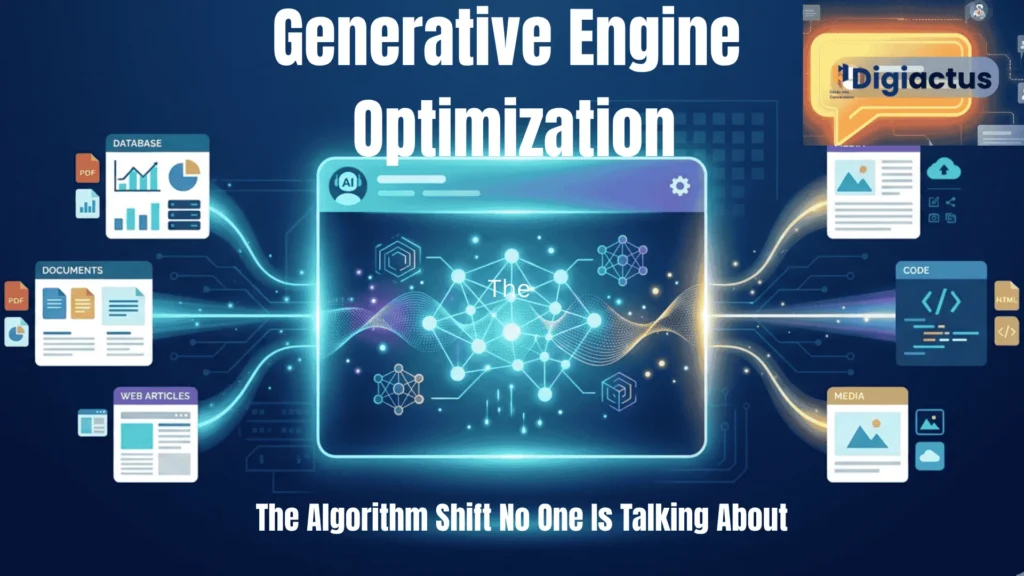
Generative AI tools use a process called Retrieval-Augmented Generation (RAG). In plain English, this means the AI searches a large body of content, retrieves the most relevant and credible pieces, and then synthesizes a response from those pieces. It doesn’t just copy-paste — it reads, understands, and rewrites.
So what makes it choose your content over someone else’s? A few things stand out:
Clarity. AI models favor content that’s easy to parse. Clear headings, short sentences, and well-structured paragraphs help the model extract key points.
Authority. Content that’s cited, linked to, or produced by a recognized source gets weighted more heavily.
Answer-readiness. If your content directly and concisely answers a question, an AI is far more likely to pull from it.
Freshness. Regularly updated content signals relevance, especially for fast-moving topics.
How does generative search optimization work?
Generative search optimization (also called GEO) works by making content easy for AI systems to retrieve and paraphrase. Key factors include: writing in clear, direct language; structuring content with specific questions and answers; building topical authority with depth and citations; and earning links from credible sources. Content that reads like a reliable expert source — not a sales pitch — is most likely to appear in AI-generated responses.
GEO vs. SEO vs. AEO: What’s the Difference?
People often confuse these three terms. Here’s a clear breakdown.
| Feature | SEO | AEO | GEO |
|---|---|---|---|
| Full name | Search Engine Optimization | Answer Engine Optimization | Generative Engine Optimization |
| Primary goal | Rank in Google results | Appear in featured snippets | Be cited in AI-generated answers |
| Target platform | Google, Bing | Google (Position #0), Siri, Alexa | ChatGPT, Gemini, Perplexity, Copilot |
| Content style | Keyword-rich, long-form | Concise Q&A format | Authoritative, structured, citable |
| Key metric | Rankings, organic traffic | Snippet wins | AI citations, brand mentions in AI |
| Still matters? | Yes | Yes | Increasingly essential |
The bottom line: SEO, AEO, and GEO are not competitors — they’re layers. Good GEO-friendly content almost always performs better in SEO and AEO too. Think of GEO as the next evolution, not a replacement.
FAQs: GEO vs. SEO
Q: Does GEO replace SEO?
No. Traditional search still drives enormous traffic. However, as AI-generated answers take up more search real estate, GEO is becoming an essential complement to your existing SEO strategy.
Q: Do I need a separate GEO strategy?
Not necessarily a separate one — but you do need to adjust how you write and structure content. Many GEO best practices overlap with good SEO and content marketing habits.
Q: Which AI tools does GEO target?
The main ones right now are ChatGPT (including Search), Google Gemini, Perplexity AI, Microsoft Copilot, and Meta AI. The landscape is growing quickly.
What Is GEO Marketing?
GEO marketing is the application of generative engine optimization principles to your broader marketing strategy. It’s not just a technical content tweak — it’s a mindset shift.
In traditional digital marketing, success meant clicks, impressions, and rankings. In GEO marketing, success also means:
- Your brand name appearing in AI-generated answers
- Your definitions and explanations being used by AI tools
- Your product being recommended when someone asks an AI for advice in your category
For example, imagine someone asks Perplexity: “What’s the best project management software for small teams?” If your brand’s content is optimized for GEO, there’s a real chance your product gets mentioned — even if the user never visits your site directly.
GEO marketing is therefore about building the kind of digital presence that AI engines recognize as trustworthy, relevant, and worth citing.
What is GEO marketing?
GEO marketing means using generative engine optimization to build a brand presence inside AI-generated answers. Instead of only chasing Google rankings, GEO marketing focuses on making your content the source that AI tools like ChatGPT, Perplexity, and Gemini reference when answering questions related to your product, service, or industry.
The Core Principles of Generative Engine Optimization
Here are the foundational principles that separate GEO-optimized content from content that AI simply skips over.
1. Write for humans first, AI second – This is the most important principle. AI tools are trained to detect and reward genuine helpfulness. If your content is stuffed with keywords, overly promotional, or hard to read, it will underperform in both traditional search and generative search. Prioritize clarity and usefulness above all else.
2. Structure your content with questions in mind – AI engines are question-answering machines. Use clear, question-based headings (like “What is GEO?” or “How does generative search work?”) and answer them directly and concisely in the first one or two sentences following the heading. This mirrors how humans ask AI questions — and it dramatically increases the chance of your content being used.
3. Build deep topical authority – Covering a topic once isn’t enough. AI tools favor sources that demonstrate broad and deep knowledge. Publish multiple pieces on related subtopics, interlink them, and keep them updated. This signals that your site is a reliable reference point.
4. Use citations and data – Content that includes statistics, references reputable studies, or quotes recognized experts is treated as more credible by AI models. Where possible, include current data and link to primary sources.
5. Keep your content fresh – Stale content risks being ignored in generative search results. Review and update your most important pages at least once a year — or whenever significant changes happen in your industry.
6. Aim for a conversational but authoritative tone – AI tools tend to pull from content that reads the way an expert would speak to a curious non-expert. Avoid jargon overload. At the same time, don’t oversimplify to the point of being vague. Strike a balance between approachable and credible.
How to Optimize Your Content for Generative Search
Now that you understand the principles, here’s a practical, step-by-step approach to generative search optimization.
Step 1: Identify the questions your audience is actually asking AI tools – Use tools like AnswerThePublic, AlsoAsked, or simply test prompts yourself in ChatGPT or Perplexity. Find the exact questions people in your niche are typing in, and build content around those.
Step 2: Write clear, direct answers at the top of each section – Don’t bury your answer three paragraphs in. Lead with the answer, then explain it. This structure mirrors how AI sources information and also wins featured snippets on Google — a double benefit.
Step 3: Use structured formatting – Use H2 and H3 headings generously. Break complex ideas into bullet points or numbered lists. Use comparison tables (like the one above) where relevant. Well-structured content is much easier for AI to process and cite.
Step 4: Add FAQ sections throughout your content – FAQs are gold for both AEO and GEO. They present information in the exact format that AI tools use to understand and convey knowledge. Each FAQ is essentially a pre-packaged answer ready to be cited.
Step 5: Build your E-E-A-T signals – Google’s E-E-A-T framework (Experience, Expertise, Authoritativeness, Trustworthiness) maps directly to what AI tools look for. Add author bios, publish case studies, earn backlinks from credible sites, and keep your “About” page thorough and current.
Step 6: Get cited and mentioned by others – If other websites reference your content, link to it, or quote from it, AI tools interpret this as a trust signal. PR, digital partnerships, and thought leadership content all help here.
GEO vs. Traditional SEO: A Practical Comparison
| Aspect | Traditional SEO | Generative Engine Optimization |
|---|---|---|
| What you’re optimizing for | A ranked URL in search results | A citation inside an AI answer |
| User journey | User sees your link → clicks → visits your site | User reads AI answer (may or may not visit) |
| Keyword focus | Exact-match and LSI keywords | Natural language, question-based queries |
| Content length | Longer usually ranks better | Concise, accurate sections perform best |
| Best content format | Long-form pillar pages | Structured Q&A + authoritative depth |
| Link building role | Critical for domain authority | Still important, but trust signals broaden |
| Measurability | Rankings, impressions, CTR | AI mentions, brand visibility in AI tools |
FAQs: Generative Search Optimization
Q: How long does GEO take to show results?
There’s no fixed timeline. Unlike Google, which indexes and ranks pages over weeks, AI tools update their knowledge bases on varying schedules. That said, content that follows GEO best practices often earns featured snippets and Position #0 results on Google faster, which creates a reinforcing loop.
Q: Can small businesses compete with big brands in GEO?
Absolutely. GEO rewards quality and specificity, not just domain authority. A small business that publishes highly specific, well-structured answers to niche questions can outperform large competitors who produce generic content.
Q: Do I need to optimize differently for each AI platform?
Not dramatically. The same core principles apply across ChatGPT, Gemini, Perplexity, and others. However, each platform has different content freshness windows and retrieval mechanisms, so staying current matters more than platform-specific tweaks.
Q: Is there a way to track GEO performance?
Directly tracking AI citations is still an emerging capability. Currently, tools like Brandwatch, Mention, and manual testing inside AI platforms can give you a sense of how often your brand appears in AI-generated answers. Expect dedicated GEO analytics tools to emerge as the space matures.
Common GEO Mistakes to Avoid
Even well-intentioned efforts can backfire. Watch out for these pitfalls.
Keyword stuffing still kills credibility – Repeating “generative engine optimization” fifteen times in one article doesn’t help — it actively hurts readability and AI trust signals.
Being too promotional – AI tools are not your sales team. Content that reads like a product brochure rarely gets cited. Informational, educational content wins.
Ignoring older content – Your best-performing pages from two or three years ago may be sitting on outdated information. AI models can detect stale data, and it reduces citation likelihood.
Writing walls of text – Unbroken paragraphs are hard for both humans and AI to parse. Short paragraphs, clear subheadings, and visual breaks are non-negotiable.
Forgetting about mobile readability – A significant portion of AI tool users are on mobile. Tables should be compact, fonts readable, and layouts simple.
The Future of GEO: What to Expect
Generative engine optimization is still young, and the rules are evolving. Here’s where things are heading.
AI search is likely to become more personalized. Responses may eventually be tailored to individual users based on their history and preferences — which means your brand’s relationship with its audience will matter even more than raw visibility.
Multimodal AI (handling text, images, video, and audio) will expand what GEO means. Optimizing video transcripts, image alt text, and podcast summaries will become part of the standard GEO playbook.
AI citations may become trackable. As AI platforms mature, they’re likely to offer more transparent sourcing — good news for marketers who want to measure their GEO efforts.
The brands that start building GEO-ready content libraries today will have a significant head start when these changes accelerate.
Quick Summary: GEO at a Glance
| Question | Answer |
|---|---|
| What is GEO? | Optimizing content to appear in AI-generated answers |
| Who uses it? | Marketers, content creators, SEO professionals |
| Which platforms does it target? | ChatGPT, Gemini, Perplexity, Copilot, Meta AI |
| Does it replace SEO? | No — it complements it |
| Key tactics | Clear Q&A format, authority signals, structured content, FAQs |
| Main benefit | Brand visibility in AI responses, even without a click |
FAQs: Generative Engine Optimization (General)
Q: What is generative engine optimization in simple terms?
GEO means writing and organizing your content so that AI tools choose it as a source when they generate answers for users. Instead of chasing a Google ranking, you’re building the kind of content that AI engines trust and quote.
Q: Is GEO the same as generative search optimization?
Yes — generative search optimization and GEO are the same concept. Some people use “generative search optimization” to emphasize the search-engine angle, while “GEO” is the more common shorthand used in the marketing industry.
Q: Where do I start with GEO if I’m a beginner?
Start with your existing top-performing content. Review each piece and ask: Does this directly answer a specific question? Is it clearly structured? Is the information current and citable? Apply the formatting and structural improvements outlined in this guide, then expand into new GEO-optimized content from there.
Q: How is GEO related to GEO marketing?
GEO marketing is the broader application of GEO principles across your full marketing strategy — including brand positioning, content planning, PR, and paid media — with the goal of building a presence inside AI-generated answers, not just traditional search results.
Q: Will GEO hurt my traditional SEO?
No. In fact, the two are closely aligned. Content that performs well in GEO — clear, authoritative, well-structured, question-focused — tends to perform better in traditional SEO as well. Investing in GEO strengthens your overall digital presence.
Final Thoughts
Generative engine optimization isn’t a trend to watch from the sidelines. It’s a fundamental shift in how people find information — and how brands get discovered. The good news is that the best practices for GEO aren’t alien. They’re an evolution of what good content marketing has always been: be genuinely helpful, be credible, be clear.
The difference now is that your audience includes both humans and the AI tools those humans are increasingly turning to for answers. Write for both, and you’ll be ahead of the curve.
Want to go deeper? Explore our guides on AEO, E-E-A-T optimization, and content authority building.